
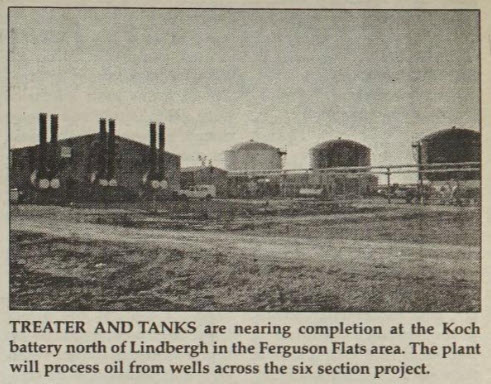
Construction of the Koch Exploration Canada, Ltd. battery in the Ferguson Flats area is going full steam ahead, and will soon be ready to collect, and treat oil from the 150 wells drilled so far in Koch's six-section project just northwest of the plant. To date, 110 of the wells _have been completed and are producing approximately 3000 barrels per day on multi-well pads, consisting of from one to eight wells each. Progressive cavity pumps lift oil mixed ' with varying amounts of water and sand from a 400 to 500 metre vertical depth, in wells that may slant as much as 45 degrees. They are electrically powered, which means they are very quiet, compared to the 360 Chevy engines used to power hydraulic pumps in areas where electrification is not feasible. The pumps are controlled by a computer which will automatically shut them down if they are plugged by sand.
Each pad has one or more “group tanks” which hold oil pumped from the wells and where a large portion of the sand suspended in the oil precipitates to the bottom. The cleaner oil then flows to what is known as a Sales tank. A third type of tank on the pad site is a “test tank,” where the product from one well is pumped for 24 hours and measured to determine that well’s production. The tanks containing produced oil are equipped with natural gas fired warmers to keep the oil at a consistency which will flow.
On a tour last week of the wellsites and plant construction, Calgary-based project manager Dean Britton pointed out that some of the pads only have one well. “We build all the pads this size, and then sometimes find there isn’t sufficient oil reservoir to drill more wells. However, it isn’t cost effective to expand the pads later.” Building full size pads is “beneficial both to us and the environment,” he noted, adding that Koch generally doesn’t build leases in the winter. “We try to pre-plan and do it in the best construction time.”
Five of the pad sites don’t yet have wellheads in place. “We will bring those into production at a regular pace. Right now there is constraint with the service industry — it’s very busy for service rigs.”
Koch is “very cognizant of the truck traffic” their many wells require to drill and operate. They are trying to address that impact through policing and community meetings and assure the area residents “it isn’t going to be like that forever.” The Ferguson Flats Road is very busy, as are many roads in the area. The oil companies have been designated by the County of St. Paul to help with road maintenance in the areas where they operate.
Currently, oil produced by Koch’s wells in, Ferguson Flats area is being, and then trucked north to the Charlotte Lake battery near Fort Kent or south to a battery near Lloydminster. When the new battery is complete, “we won't be doing that,” Britton said. Oil will be trucked to the battery for treatment and then will go by pipeline to market.
The battery is designed to handle 14,000 barrels of “dirty Oil” per day, which is added to a capacity of 14,000 barrels of cleaner oil, for a total capacity of 28,000 barrels.
Trucks will enter the battery over a scale where a sample of oil is taken to determine the specific gravity of the load. After the oil is emptied into one of a row of “dump pits,” the truck will weigh again on its way out of the plant and the difference in weights will be calculated with the specific gravity to determine the volume delivered.
Project Manager Chris Bayle joined the tour to explain the process of treating the oil. It goes first to a “surge tank” and then to an inlet tank on its way the treaters, which take sand and water out of the oil. Huge pits lined with two layers of plastic and clay are ready to accept up to 100,000 cubic metres of sand, which may be used for road construction or disposed of in salt caverns. Water removed from the oil will go down a disposal well, while small amounts of gas found in the oil are burned off in a flare stack. The clean oil goes to a series of huge black “sales tanks.” The battery will be tied into the Husky pipeline located approximately 150 meters to the west, which reaches from LaCorey to the BiProvincial Upgrader in Lloydminster, and will take oil from the plant to Lloydminster or to Hardisty.
There are currently “several hundred people representing a wide range of trades, on site during the construction stage. When construction is complete, the battery will be manned by six to eight full-time workers, working shifts around the clock to treat the ever-increasing volume of oil from the Ferguson Flats project