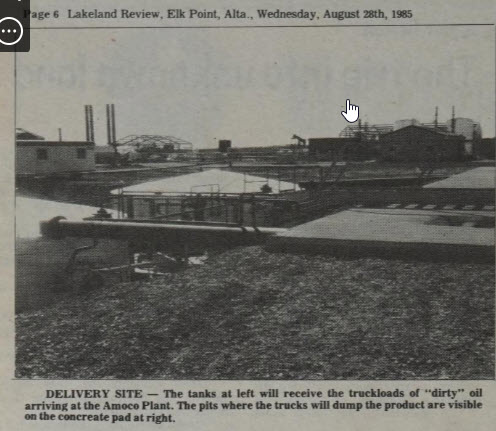
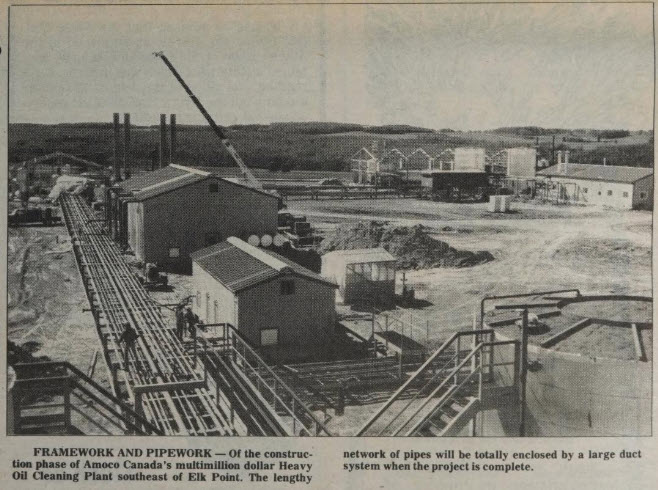
The bare, windswept hilltop, nine miles southeast of Elk Point which was the focus of nine days of hearings by the Energy Resources Conservation Board last January, has been transformed to a beehive of activity, as construction of the Amoco Heavy Oil Cleaning Plant and Steam extraction pilot project goes full speed ahead.
Amoco spokesmen Peter Giesbrecht said that actual construction of the plant got underway June 1, after a month of preliminary work on the site. A proposed startup date is estimated for the end of September.
The cleaning plant will receive the “‘sorp’’ (crude oil) from the wells dotting the countryside around the site, and will separate the oil from the water and sand it contains, ready for transport of the clean product by pipeline to Whiting, Indiana.
A projected output of four thousand barrels, (35 Imperial gallons each) per day is expected for the fully automated facility, which will require only one man per shift for its operation, plus the maintenance crews.
At the present time, a building crew of forty to forty-five workers are busily engaged in construction of the various parts of the plant, scattered over a forty acre site, and the adjacent steam extraction plant.
Approximately 25,000 man-hours of labor will go into construction of the plant, and Giesbrecht commented “‘you can multiply that by 15 to find the dollars spent on labor.” This formidable figure, however, is dwarfed by the material costs of near $4 million.
Roughly 50% of the workers are from within a 50 mile radius of the site, although a shortage of skilled local manpower sent Amoco out of the area to find the necessary workmen, Kash Verma of Amoco noted.
The main contractor on the plant is Monad Construction of Calgary, while five subcontractors come from Calgary, Edmonton and Bonnyville.
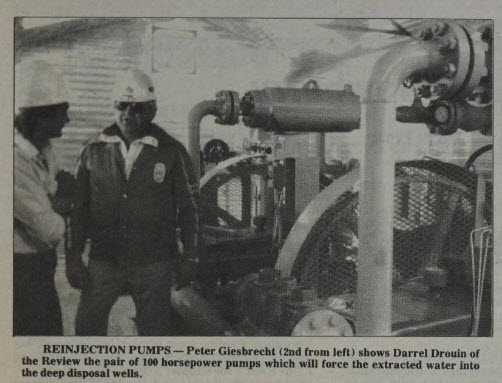
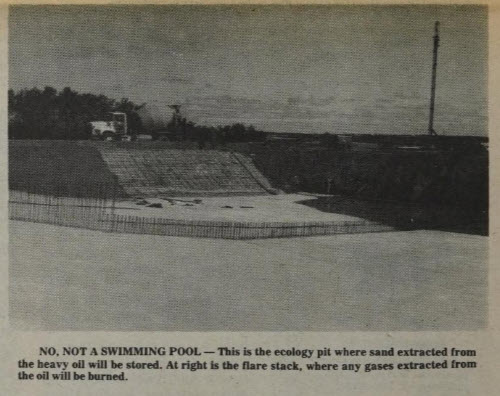
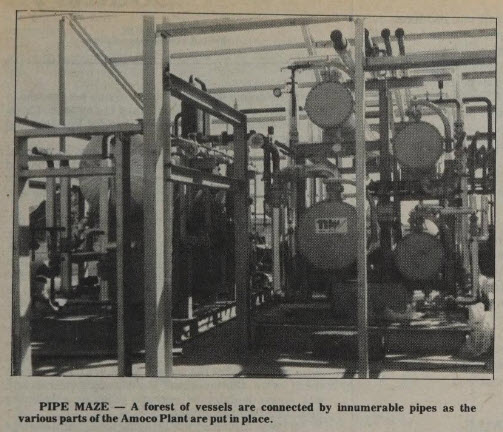
A tour of the site shows a dumping facility for the untreated product, settling tanks to remove sand and water, extractors to remove more water, storage tanks for the cleaned oil, huge pumps to re-inject extracted water to a formation 2,000 feet below the surface, a storage pit for the sand, and a maze of pipes connecting the various parts. Immense generators, walls of control panels, and heat and chemical treatment units are also part of the complex.
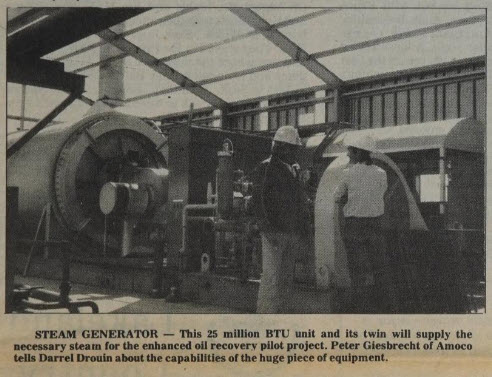
Toward the south side, a pair of giant steamers, each capable of heating 250 average sized homes, and a building crammed with inlet and outlet manifolds and controls are being made ready for the steam-enhanced oil recovery pilot project.
The wind blows on unconcerned with the changed landscape, and only slightly warmer than that which greeted the ERCB on their tour of the empty site, seven months ago.