
The treed benchlands above the North Saskatchewan River, where the hunters’ of three great tribes brought. their furs and pemmican to trade with two rival trading posts almost 200 years ago, are the focus of a summer search for insight into the impact of the meeting of native and European cultures in the fur trading days.
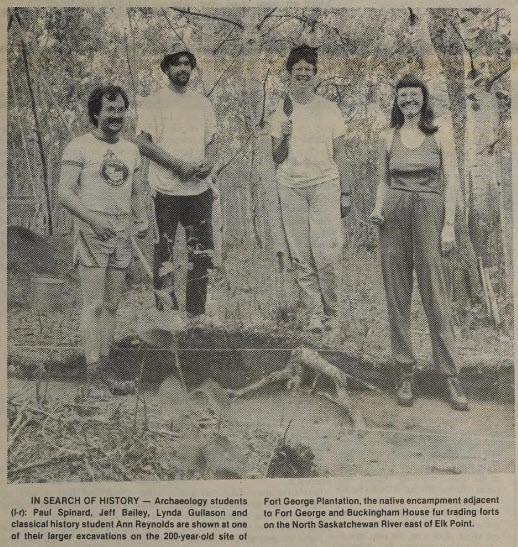
Little remains visible of the twin forts, the Hudson’s Bay Company’s Buckingham House and the North West Company’s Fort George, or of the native encampment that stood nearby—to the average eye, that is. But to University of Alberta Archaeology student Linda Gullason and her three teammates, the area teems with the past, just waiting to be discovered.
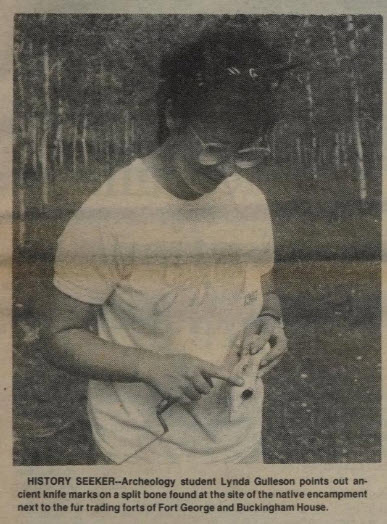
Ms. Gullason points to a series of darkened rocks: a sign of a campfire of two centuries ago. A shallow square pit nearby has yielded fragments of burnt bone, a charred beam, square nails and lumps of chinking, indicating that this has been a building site. A large animal bone lying nearby shows the marks of a knife, and has been broken in two, apparently to get to the marrow.
The area where she and fellow U of A students Ann Reynolds and Jeff Bailey and University of Calgary student Paul Spinard are conducting their work, she says, is the Fort George Plantation, where the Cree and Assiniboine hunters bringing in their furs, and the Blackfoot bringing their pemmican, set up their lodges as they prepared to visit the forts.
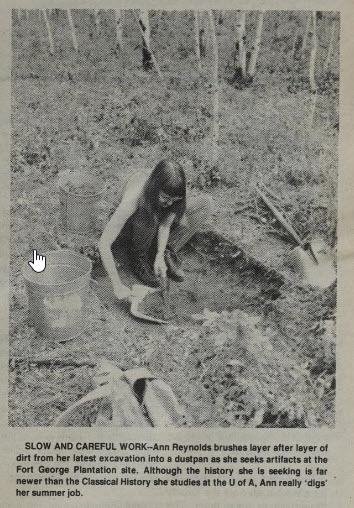
The crew came to the site almost a month ago, and spent their early days hacking away the thick undergrowth and dividing the area into sections designated with bright orange surveyors’ flags. Now, the site is pockmarked with a number of shallow, two foot square ‘test units’, each cornered with a numbered stake, where the density of the soil has been carefully tested and recorded, and any interesting finds carefully stashed in labeled paper bags. Work is conducted with pointed trowels, dustpan-like scrapers, and brushes to remove the soil a tiny layer at a time.
A large digging, with a dirt pile topped with a suspended screen sifter alongside, yielded only some bone and a thumbnail sized hide scraper, Ms. Gullason said. ‘We saw a large hump, and some depressions, and thought we had found something...but it was probably just an old anthill.’
A large concentration of fire blackened rocks, and intriguing bumpy terrain is this week’s project. ‘It looks exciting...we may find something here.’
What they hope to find are artifacts which will show the retention of native ways, such as arrowheads and hide scrapers, plus the addition of the European influence which came with the fur traders: such things as metal needles, glass beads and the like. Ms. Gullason feels that in previous studies of the coming of the fur trade to the west, ‘the historians have neglected the concept of the meeting of cultures. I think that it is important and deserves to be looked into.‘