
September 7 1988
1.3 million for development
No York boats packed with trade goods plied the sunny ripples of the North Saskatchewan, and no prime beaver pelts were on offer, but the excitement was never higher on the grassy benchland southeast of Elk Point, as government officials and history buffs gath_ered for the unveiling of plans for a major historical development at the site of two of Alberta’s earliest fur trading posts, Fort George and Buckingham House. A joint announcement by the Honorable Greg Stevens, Minister of Culture and Multiculturalism, and Deputy Prime Minister Don Mazankowski of the approval of over $1.3 million in funding for the project brought an end to many years of hoping that some day the significance of these sites would be recognized. A total of $1,385,250 has been committed from the Canada/Alberta Northern Development Subsidiary Agreement over the next four years to provide for the construction of trails, signs, improved site access, and a small visitor reception centre with associated illustrations. Stevens noted that this is only a beginning toward the Elk Point Historical Society’s hope for total reconstruction of the two forts, and pledged help in finding funds to continue the development.
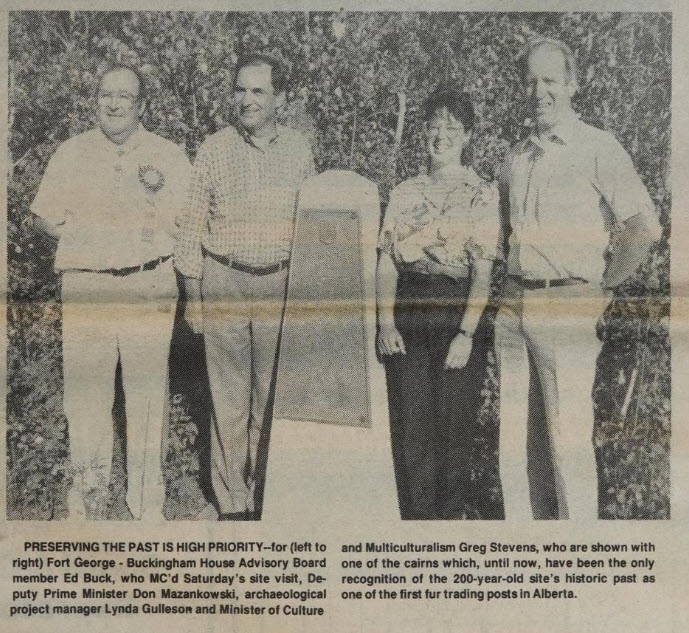
Mazankowski saluted those who had contributed to the plans for development, as ‘a demonstration of what can be done when everyone works together.’ The project will create up to 35 jobs, as well as enhancing the tourism potential and ‘putting this part of Alberta on the map in a more significant way.’ He said that the Federal and Provincial Governments are happy to play a part in bringing the plans to reality, ‘together, we have done it with you’
‘The past is here,’ MLA John Drobot told the gathering, touching on the courage, perseverance and hard work of the fur brigaders who established the forts, their legacy serving as a ‘shining example to the Historical Society.’ He urged reconstruction of the forts to preserve the history of the era, as ‘too much has already been lost.’ Drobot paid special tribute to former Historical Society cornerstone Mary Bennett who spent countless hours in planning and lobbying for development of the site, but whose life was claimed by cancer before she could see the results of her work and that of historical Society’s hope for total reconstruction of the two forts, and pledged help in finding funds to continue the development.
Mazankowski saluted those who had contributed to the plans for development, as ‘a demonstration of what can be done when everyone works together.’ The project will create up to 35 jobs, as well as enhancing the tourism potential and ‘putting this part of Alberta on the map in a more significant way.’ He said that the Federal and Provincial Governments are happy to play a part in bringing the plans to reality, ‘together, we have done it with you.’
‘The past is here,’ MLA John Drobot told the gathering, touching on the courage, perseverance and hard work of the fur brigaders who established the forts, their legacy serving as a ‘shining example to the Historical Society.’ He urged reconstruction of the forts to preserve the history of the era, as ‘too much has already been lost.’
Drobot paid special tribute to former Historical Society cornerstone Mary Bennett who spent countless hours in planning and lobbying for development of the site, but whose life was claimed by cancer before she could see the results of her work and that of her fellow supporters. ‘Mary must be smiling up there because at last (the plans) may become a reality.’
Minister of Public Works, Supply and Services Ernie Isley addressed the tourism aspect, calling the site ‘our answer to the Reynolds Museum, Head-Smashed-In Buffalo Jump, and the Tyrrell Museum. If we attract the rubber-tired traffic to this area, they will go on to other tourist spots in the Lakeland.’ Isley introduced Yvette Vincent, the first northeastern Alberta appointee to the Alberta Historical Foundation, and Lakeland Tourist Association Manager Lise Langevin.
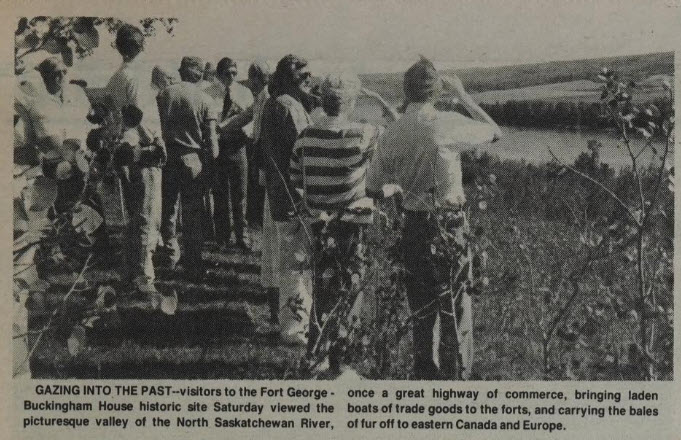
Sid Holthe of the Elk Point Historical Society gave a brief historical perspective of the site, with the North Saskatchewan as a barrier between the ‘canoe Indians to the north and the mounted Indians to the south’ who both discovered that the ‘palefaces in the east would give up metal things to make life easier...just for furs.’ He spoke of the subsequent development of the forts by James Hughes and Angus Shaw of the North West Company and William Tomison of the Hudsons Bay Company, just a few hundred meters apart for common protection in time of unrest, which funneled the furs to the east and to Europe, and provided those heading further into the western wilderness with supplies of pemmican. ‘We must not let their story be lost. We are approaching the 200th anniversary of the founding of these forts, and we have delayed long enough.’
Frank Mayner of the Fort George - Buckingham House Advisory Board, told of the long-standing efforts of the Historical Society toward preservation and enhancement of the site, with the support of both the Town of Elk Point and the Elk Point Chamber of Commerce. The Advisory Board was started two years ago, and supports the concept of total reconstruction of the forts, plus an interpretive centre.
Archaeological Project Manager Lynda Gulleson, who has spent a fascinating summer searching the area between the forts known as Fort George Plantation, for artifacts of the Indian encampment situated there during the years the forts were in operation, told of her discoveries which will help to determine the impact of the European traders on the native population of that time. The unexpected discovery of the foundation of a building not shown on records of the forts has spurred Ms. Gulleson on to further efforts, which will continue over the next few weeks.
The visitors to the site were also addressed by Elk Point Mayor Byron Mann, who said the visit was ‘an indication that many leaders in government recognize the potential of the site,’ and by Elk Point Chamber of Commerce President Vicki Brooker, who stressed the importance of development of the site as a major tourist attraction for the Lakeland.
Tours of the site and a buffalo barbecue were also parts of the momentous day.